On 16-Apr-2016 the Village of Cambridge celebrates the 150th anniversary of its incorporation. This series explores the events that led to the union of the West End and the East End. So far we’ve learned that there were many obstacles to the union of “the Corners”, the communities stretching Main Street from Gilbert Street to Colia.
In Feb-1866 the East End and Dorr’s Corners voted to incorporate into the Village of North White Creek. The West End was trying to incorporate into the Village of Cambridge. Prominent men from each corner were making regular trips to Albany to promote their vision of a village. A united village looked far off.
Then, at 2am on Monday 12-Mar-1866, the West End caught fire. Differences were put aside and everyone came running to help save Cambridge Corners.
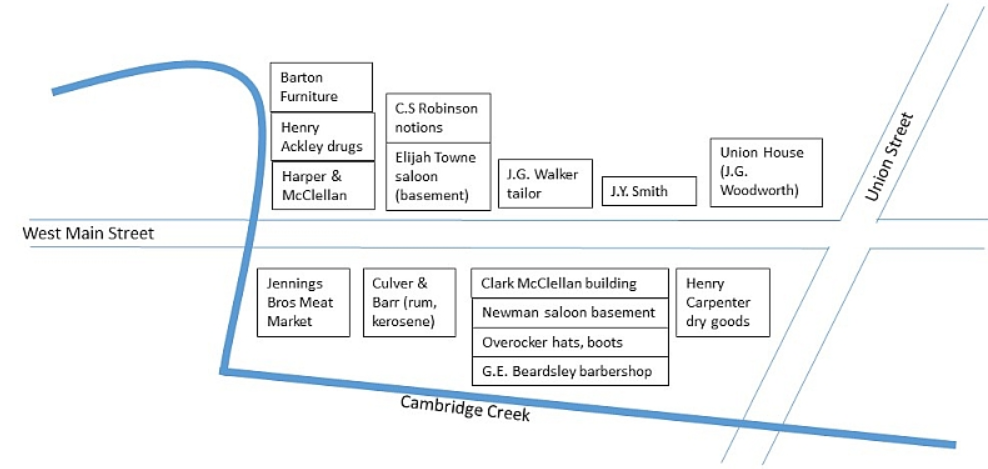
The blaze started in the Jennings Brothers meat market, located on the south side of West Main about where O’Hearn’s is today (see map). This location was long a favorite for meat processing since waste could just be dumped into the Cambridge Creek. One group of firefighters started a bucket brigade on Main Street while another attacked from the other side, trying to raise ladders up the back of the buildings and using water from the creek to drench the roofs.
Soon the fire had spread to the Culver & Barr building just east of Jennings. Kegs of rum and kerosene exploded, sparks flew, and suddenly the McClellan & Harper building across the street was afire. The entire West End, consisting of old, tightly-packed, wooden structures, was in danger. J.W. Eddy, the village insurance agent, gave the command to enter every building and toss all flammable content into the street.
Captain Henry Gray, son of Dr. Henry Gray and recently returned from the Civil War, arrived on the scene with two kegs of black powder under his arms. He ordered the demolition of the Clark McClellan building, the next building to the east on the south side of the street, to create a fire block. The powder was placed in Newman’s basement saloon but the dampness brought on by the firefighting lessened the impact of the explosion. The fire was retarded but not stopped.
Sparks from the explosion jumped to the other side of the street and attention returned to the north side of West Main. C.S. Robinson’s notions shop was on fire. More people stormed into the buildings tossing rugs, furniture, and clothing into the street.
The fire block on the south side proved fruitless and the blaze now jumped to the Carpenter building.
[note: Today the China King restaurant is located on the southwest corner of Main and Union. This brick building was erected after the 1866 fire and has the name Carpenter chiseled into the façade.]
Everyone was exhausted and still all of Cambridge Corners was on fire. J.G. Woodworth, proprietor of the Union House, knew something had to be done. So he brought beer and whiskey from his bar into the streets to help revive the firefighters. As the fire blazed for several more hours, shouts of “more water” were answered by shouts of “more whiskey”.
[note: Woodworth’s Union House survived the Mar-1866 fire, but was lost to another fire in the early 1880s. It was subsequently replaced in 1885 by the majestic Union Hotel with its four corner spires. Silvano’s restaurant occupies this space today on the north side of Main Street just west of Union Street.]
Finally the west wall of the Carpenter building fell. This opened the air flow, removing the tunnel-effect that had fueled the fire. When all was said and done, the total damages were set at $40,000. Although many praised Capt Gray’s quick thinking, Newman sued Gray for blowing up his saloon.
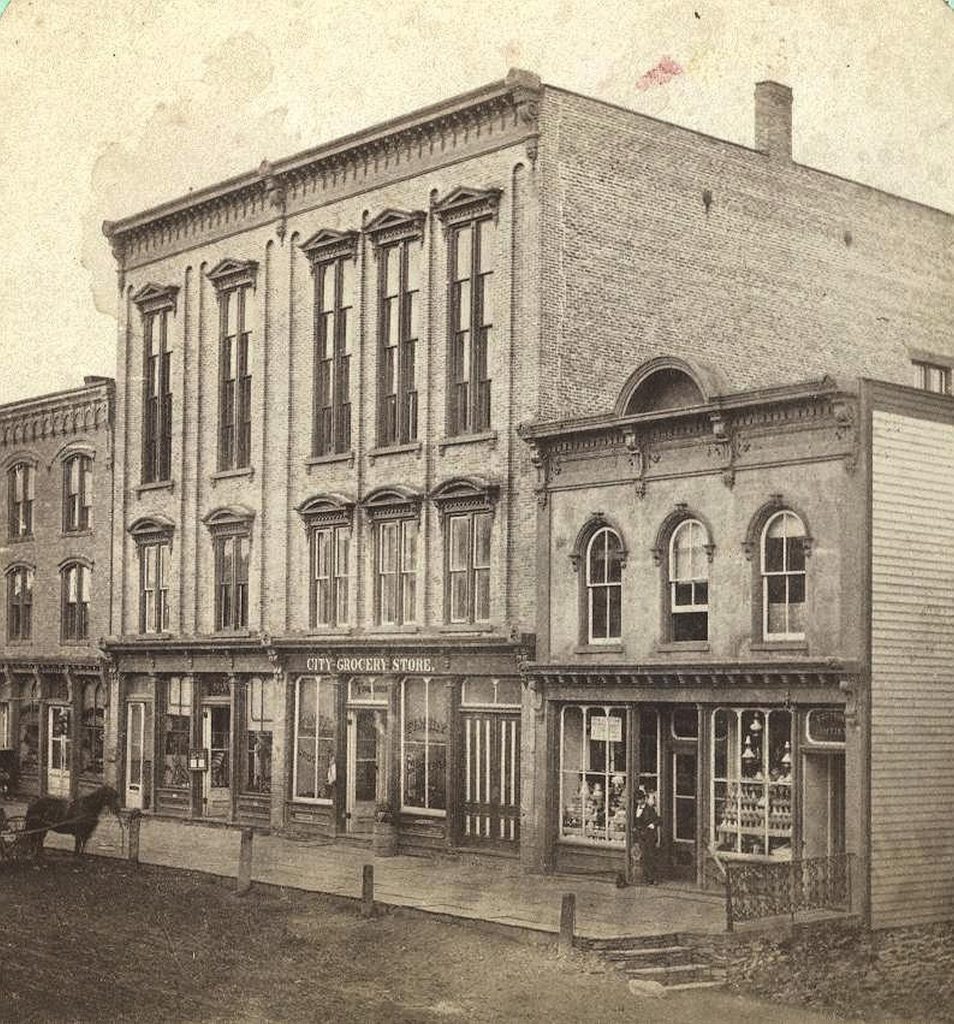
Two great Cambridge landmarks arose from the ashes of this fire. First, Henry Ackley moved his drug store to the south side of the street and erected the great Ackley Hall (see photo). It was about where John Patterson’s law office is today.
[note: In 1870, Mark Twain gave a lecture in Ackley Hall. Before the event, Twain looked out his window of the Union House and saw Ackley Hall was on fire. The lamplighter, lighting the candles to be used that evening as stage lights, had caught the stage curtain on fire. The lamplighter quickly controlled the fire. Although it survived that night, the Ackley Hall was ultimately destroyed by fire in Dec-1884, a blaze so monumental that it was covered by the New York Times newspaper.]
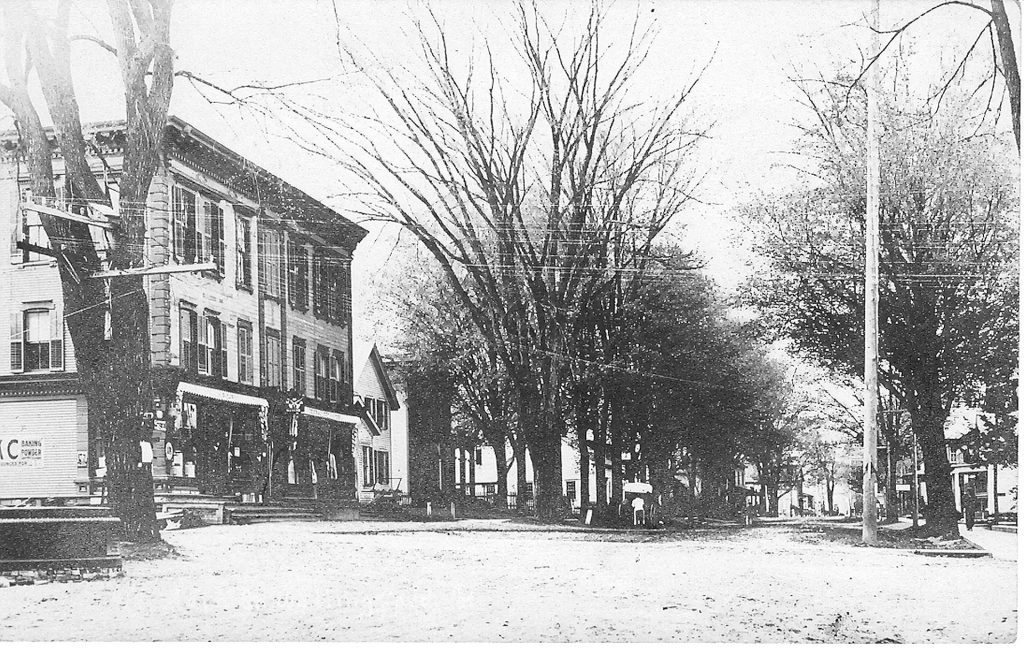
Second, Mial Barton’s furniture business was growing and he erected the large yellow building on the north side of Main Street across from the bank (see photo). Today this is the Cambridge Antique Center.
The West End fire helped everyone finally see that differences needed to be put aside and a union was necessary for the community to survive. On Monday 16-Apr-1866 a proposition to incorporate North White Creek, Dorr’s Corners, and Cambridge Corners into the Village of Cambridge was approved by the NYS Senate and Assembly. Coila had once again said “no thanks” when asked if they wanted to be included.
But disagreement was not over. The incorporation charter, intended to unite the community, separated the newly formed village into an East District and a West District with three trustees from each end. So we were united and yet we were not. Also, the incorporation charter that had caused much debate for many years, the one that was approved on 16-Apr-1866, that charter was amended by the citizens of the Village of Cambridge six times over its first 10 years. We’ll get into that in next week’s article.