On 16-Apr-2016 the Village of Cambridge celebrates the 150th anniversary of its incorporation. This series explores the events that led to the union of the West End and the East End. So far we’ve learned that “the Corners” were physically and logically separated and that they had a strong mistrust of each other.
Many felt that incorporation into a village was the only way to address the need for municipal services such as a fire department, a water company, a police department, and a maintenance department for roads, bridges, and sidewalks. Others felt that private companies could provide the services without the need for a public union.
The need for action was growing in 1864 as the community suffered from fires, drunkards, and lawless disorder in our streets. In November 1865 James Smart, the new editor of the Washington County Post newspaper, put forth yet another argument for unity … our post offices.
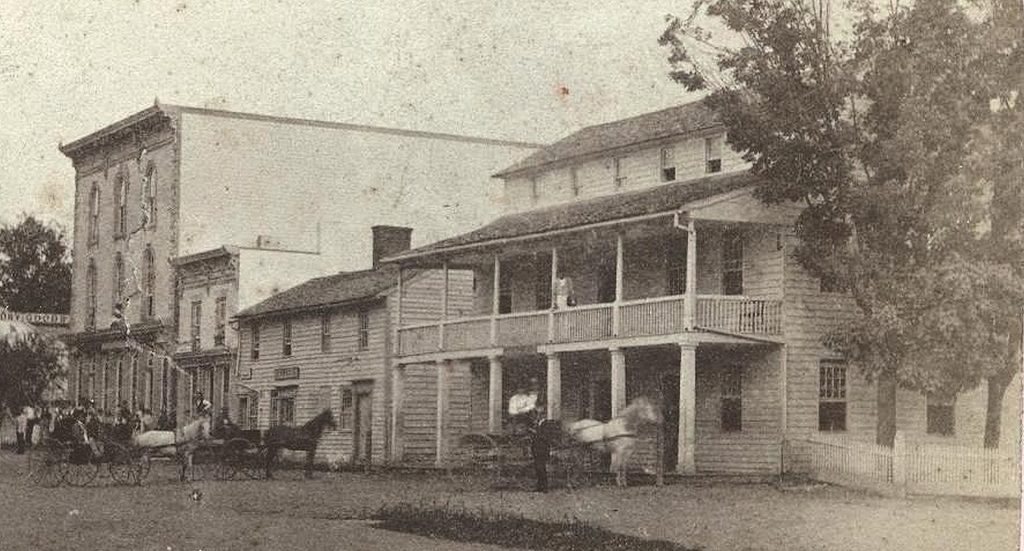
The first post office in Cambridge was in Adonijah Skinner’s tavern located on the southeast corner of Main and Park streets (see photo). Around 1829 Matthew Stevenson became postmaster and moved the post office to the West End where he lived. The post office moved into the building on the northeast corner of Main and Union streets where Ed Levin Jewelry is located today (see photo).
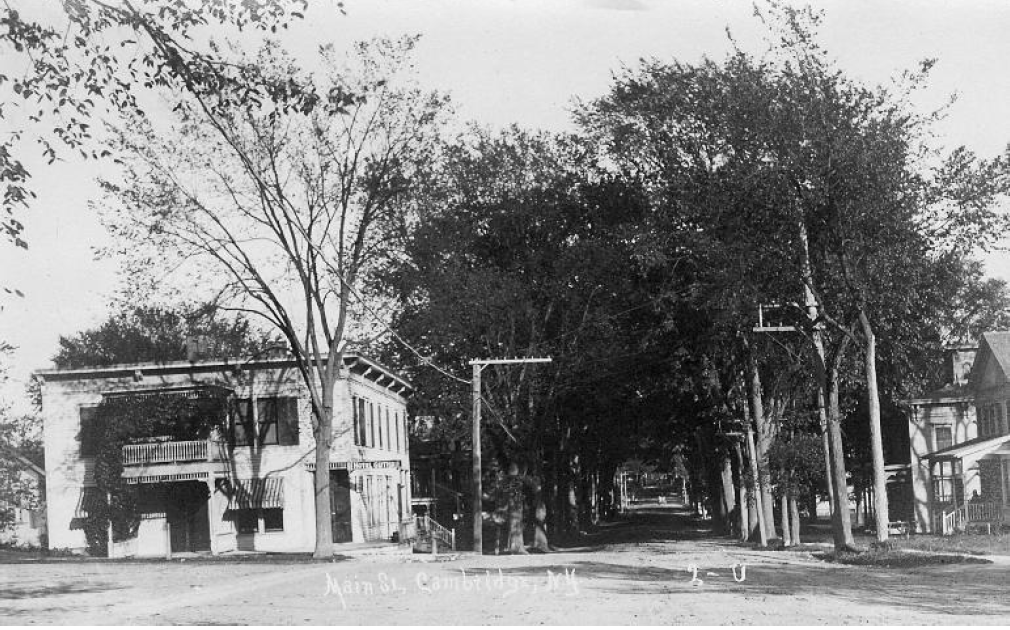
The Crocker family owned much land near the railroad tracks, including R.K. Crocker’s brick building on the south side of Main Street just west of the tracks (the Jerome Wright insurance building in the 1960s and today the Village Co-op). The Crockers hoped to lure businesses to the middle of the community in an attempt to economically unite the West End and East End.
One such move by Crocker was to provide land on the north side of Main Street between what is today Broad Street and St Lukes. Crocker thought it an ideal location for a united post office (see photo). Instead the East Enders petitioned the US Government to have its own separate post office called North White Creek. The post offices were separating, not uniting, the Corners.
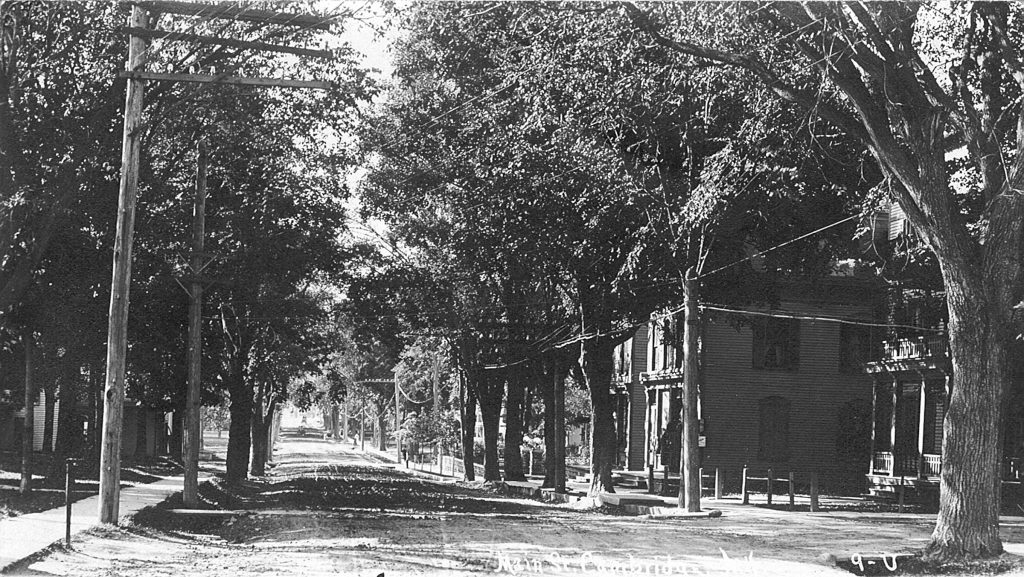
In early February 1866, Cambridge Corners and North White Creek held the first official meeting to discuss incorporation. The meeting was held on the West End at Woodworth’s Hotel, an early name for the Union Hotel. B.F. McNitt was the strongest proponent and offered a resolution that Dorr’s Corners, North White Creek, and Cambridge Corners incorporate to form the Village of Cambridge.
McNitt’s brother-in-law, Harmon Sharpe, was the strongest opponent of incorporation and offered two reasons to defeat McNitt’s motion. Sharpe argued (1) “God ordained that North White Creek have mud for sidewalks”; and (2) “water obtained by bucket was the proper way to put out a fire”. The audience laughed, but Sharpe was serious.
A third illustrious citizen of the day, J.J. Gray, offered another option. He said incorporation was not the issue, the creation of a fire fighting organization was the true need. Gray proposed that a fire department be created and funded via subscription without the need for an incorporated village.
This first meeting ended with shouting and no progress.
On Saturday 17-Feb-1866 a second meeting was held. This was held on the East End in the Porter & Higgins dry goods store (today Ace Hardware store, owned by descendants of Porter). J.W. Eddy, the local insurance agent, proposed the incorporation of just the East End to include all land (a) east of the Turnpike; (b) north to Jackson town line; (c) south to the “fork in the road”; and (d) east to the Furnace (the foundry just south and east of the intersection of Main and Gilbert streets).
J.J. Gray again opposed incorporation and submitted a motion to create a private fire department. Gray lived in the house that is today The Mansion also known as Cambridge Guest Home or Meikleknox.
Martin Hubbard was in favor of incorporation but only if it included the West End. He offered an amendment to make the western boundary not the Turnpike but Johnson’s tannery pond (West Main Street and Center Cambridge Road).
Then someone shouted “What about Coila? Do we include them?”
The craziness increased when Isaac Brownell who lived south on the Turnpike, asked if he could make an amendment to include just his house in the new village even if the West End was not included.
A vote was called and it was decided to incorporate the East End only into the Village of North White Creek. Another vote was called on the proposition to ask the West End if they wanted to be included. That was defeated. Another vote was called on the proposition to ask Coila if they wanted to be included. That was also defeated.
The East End was all set to unite into a village but only including from the Turnpike to Dorr’s Corners (from Union Street to Gilbert Street). A committee of 7 was established to draw up the Act of Incorporation, papers that did not include the West End. The committee members were B.F. McNitt, P.H. Neher, D.M. Westfall, Fletcher Baker, S.W. Crosby, X.J. Maynard, and James Thompson.
It appeared a village might be formed, albeit one much different than our current one. The question was evolving from one of whether we should incorporate to one of where would be the boundaries of the new village. Would it include the West End? Coila? Ash Grove? Would there be one village or two? Next week we’ll see that more meetings were leading toward less unity.