So far this series has covered the raucous road to incorporation that led to the formation of the Village of Cambridge on 16-Apr-1866. Now we’ll covers some major, subsequent steps along our village’s 150-year history.
Change in Cambridge
On 23-Jul-1761 King George III approved the Cambridge Patent granting 30,000 acres to our original 30 settling families. Over the next 130 years there are three periods of major change in early Cambridge.
First, 1791 started a period of rapid settlement by Scotch Presbyterians and New Englanders of English descent. It marked the transformation of a beautiful wilderness into a sturdy God-fearing community
Second, by 1851 the Irish had arrived and made their mark on the social structure of Cambridge. The railroad was building and about to open to Cambridge the world and its markets.
Third, 1891 was the beginning of the modern age in Cambridge. The Union School opened, the village sewer was started, the Cambridge Fair was moved from Lauderdale to the village, and electricity came to Cambridge. We’ll start with the topic of electricity, but first let’s paint a picture of life in Cambridge in 1891.
Cambridge in 1891
Main Street was unpaved, deep in dust, and heavily tree-lined. Houses were lighted with Rochester burner kerosene lamps. Street lighting was by kerosene lamps trimmed and lighted each night by Edward Boland, our village lamplighter, for $4.40 per week.
The bustle was still in fashion and women wore enormous hats and great puffed sleeves. Skirts had to be modestly held to prevent dragging in the dirt. Fleece lined wool had replaced red flannel underwear. Boys came home from college sporting tennis blazers, tuxedoes, and sharp pointed yellow shoes.
Benjamin Harrison was president. The Hollister boys were the stars of the local Cambridge baseball team.
The town supervisors were William Almy (Cambridge), L.E. Nicholson (White Creek), and James Robertson (Jackson). The village president was H.H. Parrish and the trustees were Thomas Thompson, Willard Lawton, H.H. Lovejoy, Thomas LeGrys, J.R. Hitchcock, and Walter Galbraith.
George McFarland was president of the Board of Education and James Potter had just been hired as the first principal of the new school. A.G. Taylor was cashier at the bank. C.E. Lyons was Master of the Masons.
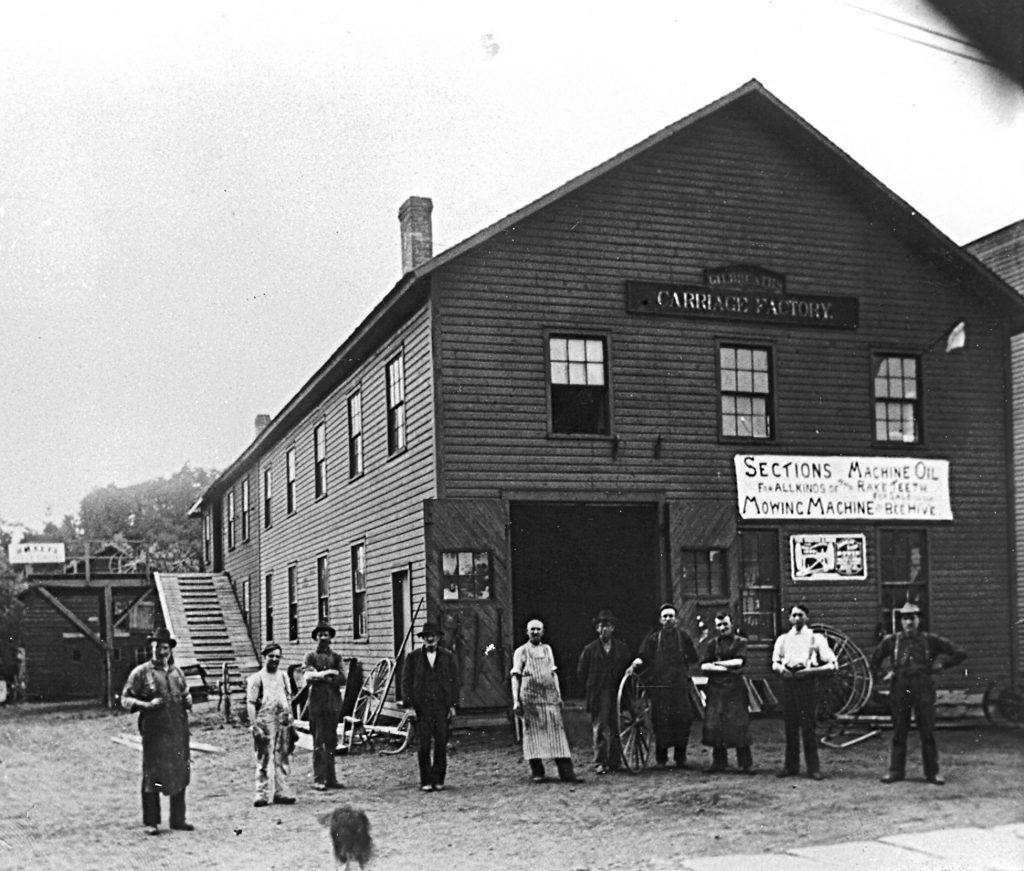
Leading stores were McNish, Carpenter, Copeland, Frisbee, Cramer, Crocker, Eldredge, and Nicholson. There were five blacksmith shops and four carriage manufacturers (see photo). The barbers were Julius Mollier and J.J. Powers. Charles Battle dealt in hides and tallow at the old tannery.
The lawyers were John Larmon, C.O. Pratt, John Pratt, and Westfall & Whitcomb. The milliners were Jennie Reid and Emma McCall. Minnie Johnson was a dressmaker and Joseph Paro was the tailor.
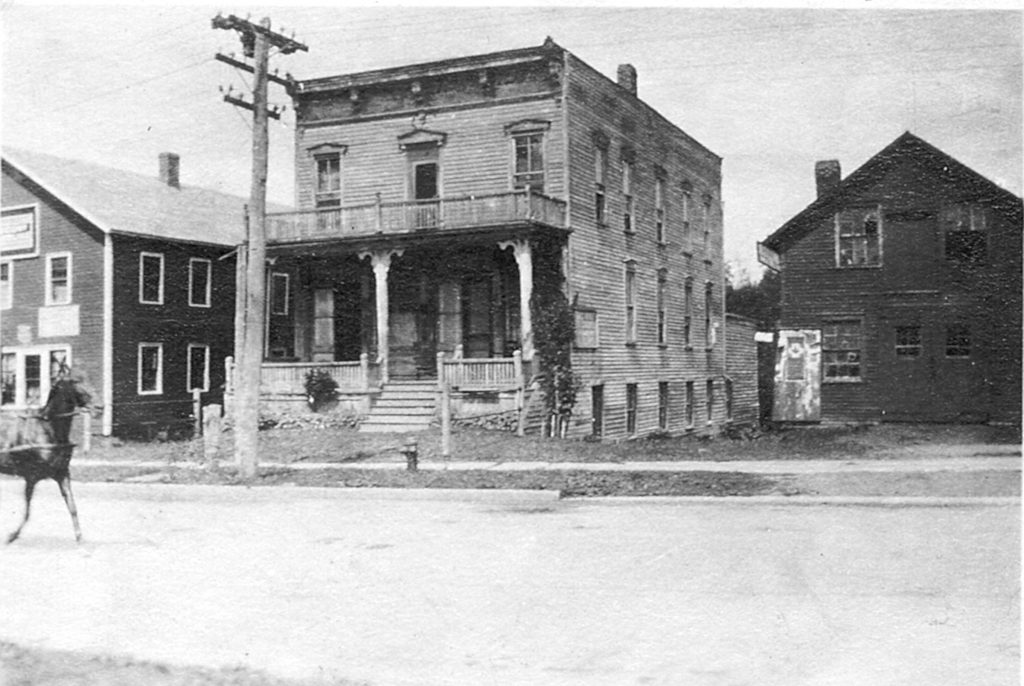
The doctors were D.A. Chase, L.A. Clark, F.E. Lewis, J.F. Niver, and T.C. Wallace. The ministers were Henry Gordon, L.W. Beattie, H.G. Blinn, Thomas Fields, H.T. Horsfield, and M.J. Chapman.
Lighting our Streets
In 1890 the streets of Greenwich had been outfitted with thirty open arc lamps. Hoosick Falls streets had electric lights. In 1891, it was Cambridge’s turn.
Although the East End and the West End had formally united into the Village of Cambridge in 1866, the two communities retained much of their independence and much of their distrust of each other.
After nearly 100 years of maintaining separate school districts, the East End and West End finally agreed to build a single school. It was to be located in the middle of the village on land donated by J.B. Rice after he had filled in much of the Cambridge Swamp. [note: We’ll get into the history of Cambridge schools in a later article]
I suspect parents in 1891 were concerned about sending their children to school in the middle of the village rather than to a school on their end of the village. Electric street lights would make it safer for the children to walk to school.
Cambridge’s Electrical Plant
E.P. Cramer, C.T. Hawley, and R.R. Law were appointed to identify the best source of electricity for Cambridge. They visited three nearby villages.
Ballston Spa used incandescent lamps of 25 candle power. They were shut off at 1:30am and were not lighted on moonlit nights. Saratoga used alternating electric and gas lamps. Hoosick Falls reported unsatisfactory illumination from its arc lamps.
On 29-Jul-1891 the Cambridge Electric Light & Power Company was incorporated to supply electric lights to the towns of Cambridge, White Creek, and Jackson. The first directors were J.B. Rice, J.L. Agan, A.B. McNish, W.L. Hitchcock (my great grandfather), A.D. Frisbee, Eugene Weir, and Ensign Copeland.
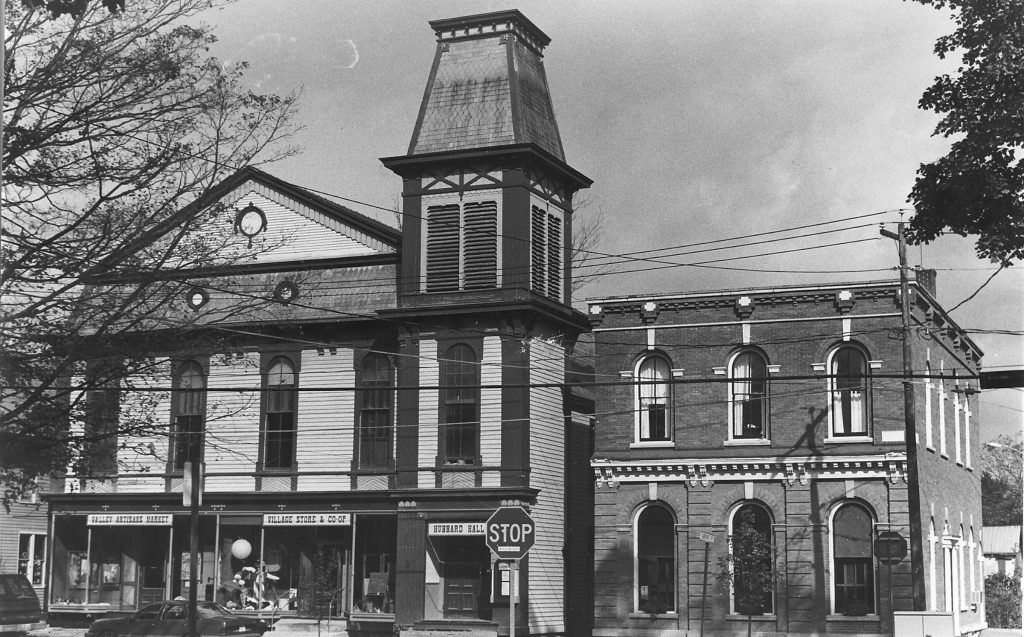
On 28-Aug-1891, the trustees of the Village of Cambridge voted to have the Cambridge Electric Light & Power Company install one hundred 25 candle power lights. The original plan was for lights to be lighted all night every night, but that was quickly changed to shutting them off at 1:30am.
In Sept-1891 the local electric company purchased the steam mill property from Amos Conkey located south of the Main Street and just west of the railroad tracks. The company signed contracts to purchase a dynamo and an engine for the electric plant.
J.B. Rice placed the first order with the new electric company to install 131 lamps in his Seed Company. Three hundred poles were installed to service the other businesses in the village. The electric street lights first came on about 1-Dec-1891.
The lamps had a U-shaped carbon filament which gave a yellow tinge which degenerated to a red glow when there was difficulty with the wood burning boiler at the primitive power plant. Electricity was used solely for electric lights as there were no other electric devices yet.
House wiring was mostly by wires run on knobs along the outside of the ceiling. The lighting fixtures were ugly and overly ornate. There was a monthly flat charge per lamp.
Next week we’ll continue our discussion. Our local electric power plant closes as our source of electricity shifts to the Battenkill in Greenwich requiring nine miles of power lines to be erected. Once we finish with electricity, we’ll cover the other two major events of 1891: the opening of the Cambridge Union School and the opening of the Cambridge Fair.