(note: click on image to enlarge)
On 16-Apr-2016 the Village of Cambridge celebrated the 150th anniversary of its incorporation. Over the past nine weeks we’ve talked about all the obstacles that had to be overcome in order to unite the West End and the East End. This week we’ll begin to look at our village since incorporation, starting with our fire department.
Our Four Fire Companies
In 1871 there were 66 members of the Volunteer Fire Dept. By 1877 they had split into two companies: Engine Co had 51 members and the Hook and Ladder Co had 24. So much for unity following incorporation.
By 1881 there was a lack of interest in the volunteer fire departments. The village trustees created a paid Fire Department was established on 20-Dec-1881. A uniform was purchased for the Fire Chief at a cost of $5.
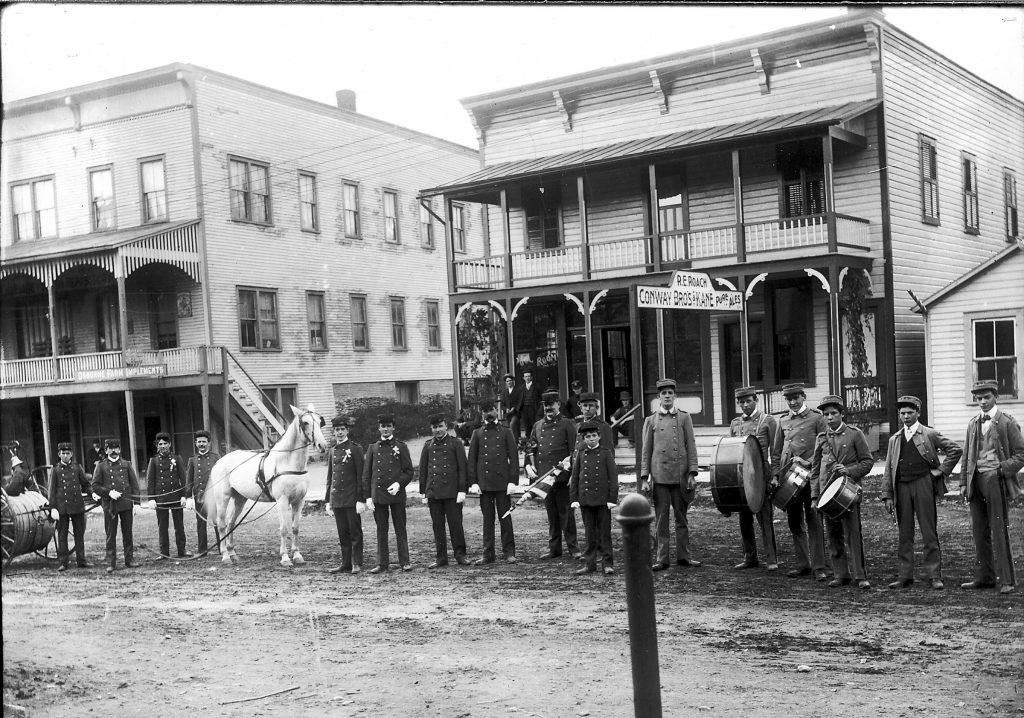
The paid fire department lasted only until 1887 when four volunteer companies were created with a limit of 23 members per unit. The Russell Hose Co #1 served the East District, the John Larmon Hose Co served the West District, the Hose Co #3 served the middle, and the JJ Gray Hooks and Ladder Co #3 went to all fires. One village, yet four fire companies. So much for unity.
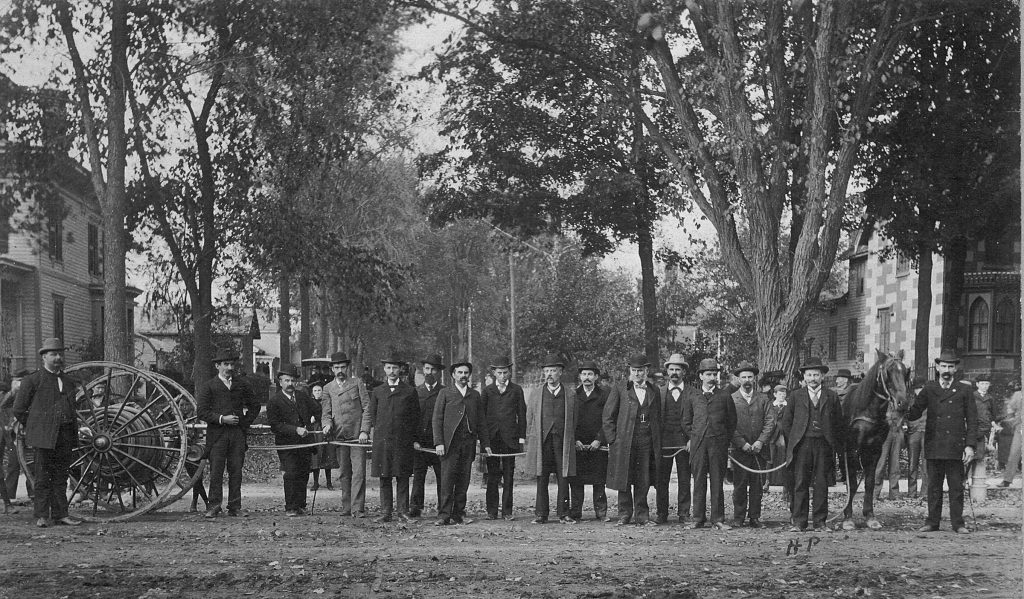
The name on the application for Hose Co #3 was left blank, but soon became known as the Hallelujah Hose Co #3 since many of the local clergy were charter members. They were once told they had to appear “in uniform” to be included in the next parade. They appeared in the parade … adorned in Prince Albert coats and straw hats (see photo).
The Hooks were famous for their annual minstrel shows of nostalgic recollection. Although disbanded around 1931 when the four fire companies were united into the Cambridge Fire Department, the Hooks continued as a social group. When they finally ceased in 1954, their last act was to donate their treasury to the United Presbyterian Church for its Carillon Fund. How fitting that the Hooks helped finance the replacement of the old church bells which for many years called them to the fire station.
The Russell Hose #1 disbanded in the early 1890s to be revived two years later under the name J.B. Rice Hose #1. Rice was the chief engineer of the fire company.
The JJ Gray Pumper
In 1868 JJ Gray was given the task to find a suitable firefighting apparatus. The pumper bore his name thereafter. In 1921 in preparation for the Firemen’s Muster in Bennington, the pumper was brought out of retirement. It was completely dismantled and reassembled tight as a drum by Tom Ryan, a local plumber.
Soon the pumper was ready to be tested at Blair’s Brook (Owl Kill) behind the McGhee Lumber Company. To the cheers of hundreds of onlookers, the JJ Gray spit the water 308 feet. From then until the muster, members of the fire department stood guard at the engine house (even sleeping there at night) to prevent sabotage by a rival fire company. Finally, at the firemen’s muster, the JJ Gray barely outshot the pumper of the Rough and Readies from Greenwich to win the annual competition
Salem Fire Dept Sends Help (again)
In 1864 the Salem fire engine was shipped on a railroad flatbed to help fight the East End fire that wiped out much of the north side of Main Street between Park and Division streets. Cambridge was mortified to have needed to call upon its neighbor … but not enough so to not let it happen again.
In March 1927 at 3am the Victory Theater caught fire. This was located in the old Congregation Chapel across from the current post office where A&M Printers is located today. The Cambridge firemen had two chemical trucks and the gravity-fed village water supply, hardly enough to save the fire from spreading and potentially wiping out the East End from Park Street to Grove Street.
Once again Salem came to our rescue, this time sending its new motor pumper. It was connected to the water supply at the corner of Washington Street and the fire was contained.
Fire Chief James Loren (with his distinctive handlebar moustache waving in the breeze) said “improvements in local firefighting did occur in Cambridge, but usually only after we had gotten a good scorching”. The following Spring the village purchased its first motor pumper.
An Unusual Fireman’s Parade
The new fire engine in 1928 led to an interesting circumstance as the result of Cambridge still having four separate fire companies. The firemen wanted a parade to show off the new engine, and each company wanted to drive.
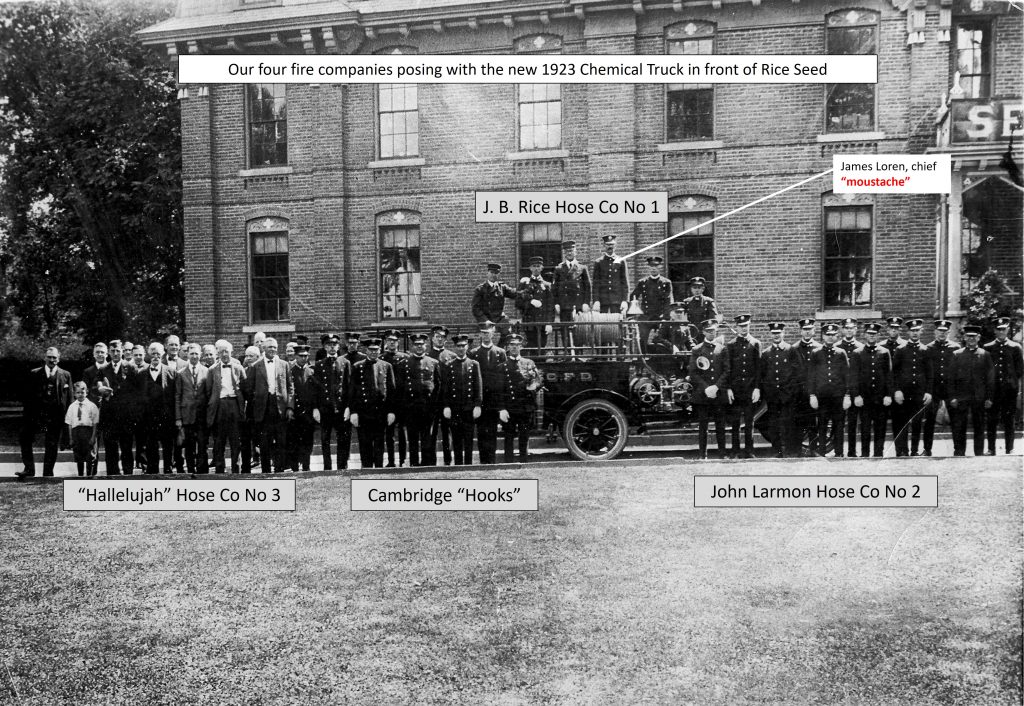
The parade started in the middle of the village at the JJ Gray Engine House. The Cambridge Hooks drove the fire engine from the fire house heading eastward toward Dorrs Corners with the other three fire companies marching behind. When the parade reached its most easterly point, they descended and the JB Rice Hose Company hopped aboard to drive the engine westward back to the railroad tracks. There the John Larmon Hose Company took to the driver’s seat taking the fire engine to the most westerly point. Finally, the Hallelujah Hose Company had its turn, driving the engine back to the fire house.
Colonel Charles Raymond
Many thanks to “the Colonel” for some of the material in this week’s article, such as this. Shortly after his family moved to Cambridge when he was 11, Sutherland’s Garage on Main Street caught fire. The schoolboys all rushed to the windows when they heard the church bells of the two Presbyterian churches. They saw the two-wheeled hose reel rattling along Main Street being towed by two delivery trucks. Not far behind was the “ungainly hook and ladder cart with its stack of ancient red hand-hewn ladders and its front-and-rear steering handles, hustling along the brick as fast as its crew could drag it on foot”.
Next week we’ll talk about the coming of electricity to Cambridge