The first portion of this series covered the incorporation of the Village of Cambridge on 16-Apr-1866. Now we’re covering some major, subsequent steps along our village’s 150-year history.
1891 – a big year
1891 was the beginning of the modern age in Cambridge. The Union School opened, the village sewer was started, the Cambridge Fair was moved from Lauderdale to the village, and electricity came to Cambridge. This week we’ll finish the topic of electricity that we started last week.
Electricity – quick recap
On 28-Aug-1891, the trustees of the Village of Cambridge voted to have the Cambridge Electric Light & Power Company install electric street lights. The electric plant was built on the Amos Conkey steam mill property, located south of the Main Street and just west of the railroad tracks. The street lamps often dimmed to a red glow when there was difficulty with the wood burning boiler at the primitive power plant.
Electricity from Battenkill
The power companies in Greenwich and Cambridge merged on 21-Mar-1893 to form the Consolidated Electric Company. The Cambridge headquarters for the power company was the J.L. Agan furniture store (across from today’s bank). The Agans and his successor, E.C. Oatman, attended the operations of the Cambridge territory for many years. The crew of Jim McOmber, Edward Blanchfield, Charles Smith, and Mickey McDonald used a one-horse lumber wagon as they maintained the nine-mile two-wire transmission line from Greenwich.
Cambridge, always conservative in its actions, was slow to adopt electric lighting in businesses and houses. Among the first houses to be lighted by electricity were J.L. Agan, , J.B.Rice, and Kate McKie (today the Cambridge Historical Society).
As electricity spread across the country, electric devices besides lamps came into being. The electric flat iron came first by the middle of the 1890s followed by the electric washing machine. The advent of electric laundry equipment forced the electric company to provide 24-hour service by the turn of the century. By 1900 there were still only 59 electric customers in Cambridge.
In 1896 a step-down transformer was installed in the Cambridge sub-station located behind the fire station. In 1909 a third wire was added to the transmission lines providing three-phase service. In 1926 a new 33,000 volt, three-phase transmission line was built from Middle Falls to the new sub-station on the west boundary of the village. Another transmission line came from the Johnsonville hydro station.
The flat rate per lamp per month prevailed until 1907 when meters were installed for each customer and electric service was sold by the kilowatt hour. The village became darker in the evening as previously people had left all of their lights on all of the time when paying a flat rate.
By 1920 many small factories were operated by electricity. Electric ice cream makers came into fashion. Tungsten filaments greatly improved the efficiency of the electric lamp. Portable floor and table lamps were introduced. A handful of electric ranges were in Cambridge in the 1910’s.
Following the first World War, farmers began using electric milking machines. Households began using electric refrigeration. Radios were becoming popular.
To keep up with the growing demand, the Consolidated Electric Company merged with the Adirondack Power & Light Corporation in 1927. That company merged with several others to form the New York Power & Light Corporation. This was connected to the Niagara Hudson Power Company’s power source. This meant that while our primary source of power came from the Battenkill it was backed by Niagara Falls.
Farms
In 1920 there were fourteen farms in Cambridge with electric service. A considerable portion of the cost of the service lines had to be paid by the farmers so these fourteen farms were either within the village or close by.
In 1924 the Adirondack Plan was introduced to build service lines wherever there could be a minimum monthly revenue of $24. Over the next ten years, 29 miles of line was installed, servicing 180 customers 100 of whom were farmers. The longer lines went to Eagle Bridge, White Creek, Lauderdale, and Center Cambridge.
In 1935 the Rural Plan was introduced to build service lines at minimum monthly charges of $2 to $4.50 based on the length of the line. Over the next two years, 41 miles of line was installed servicing 158 customers 126 of whom were farmers.
Fifty Years Later
As World War II began Cambridge had 161 electric ranges, 192 electric refrigerators, 35 electric hot water heaters, 779 electric flat irons, and 831 radios. To quote the local newspaper “everyone had a motor car, electric lights, and a radio” This appears to be a slight exaggeration since several dozen homes in Cambridge were still without electricity.
Telephone Service
Early telephones were leased in pairs and communication was only possible between the two instruments of the same pair (think of two tin cans connected with string). The first telephone exchange was installed in Cambridge in 1900. It was located over Frisbee’s store and Mabel Frisbee was the operator. The exchange allowed its 150 subscribers to talk to any other subscriber in the village.
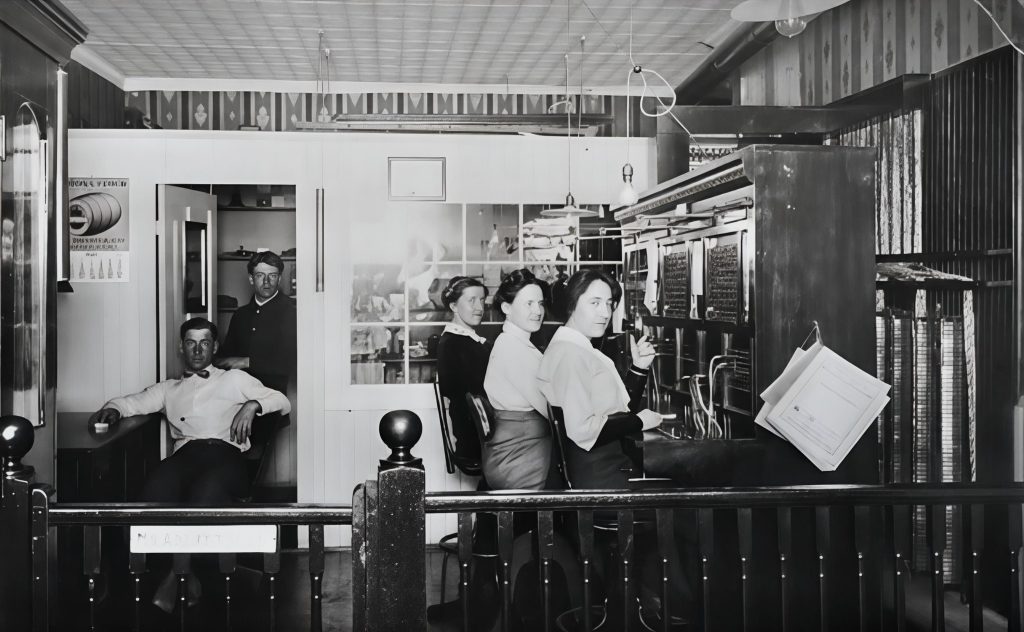
In 1903 the Hudson River Telephone Company established an exchange in the village. In 1905 the Granville Telephone Company purchased the exchange. Manager Grant Danyew moved the growing business to the Hotel Cambridge. In 1916 the exchange was moved to its new office (today this is Don Brennan’s house across from the post office).
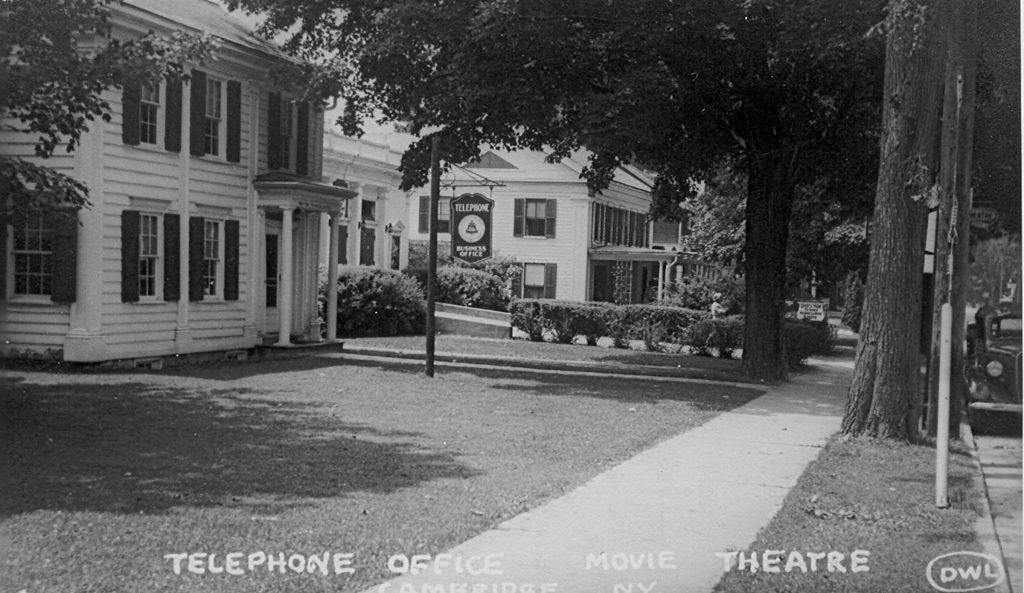
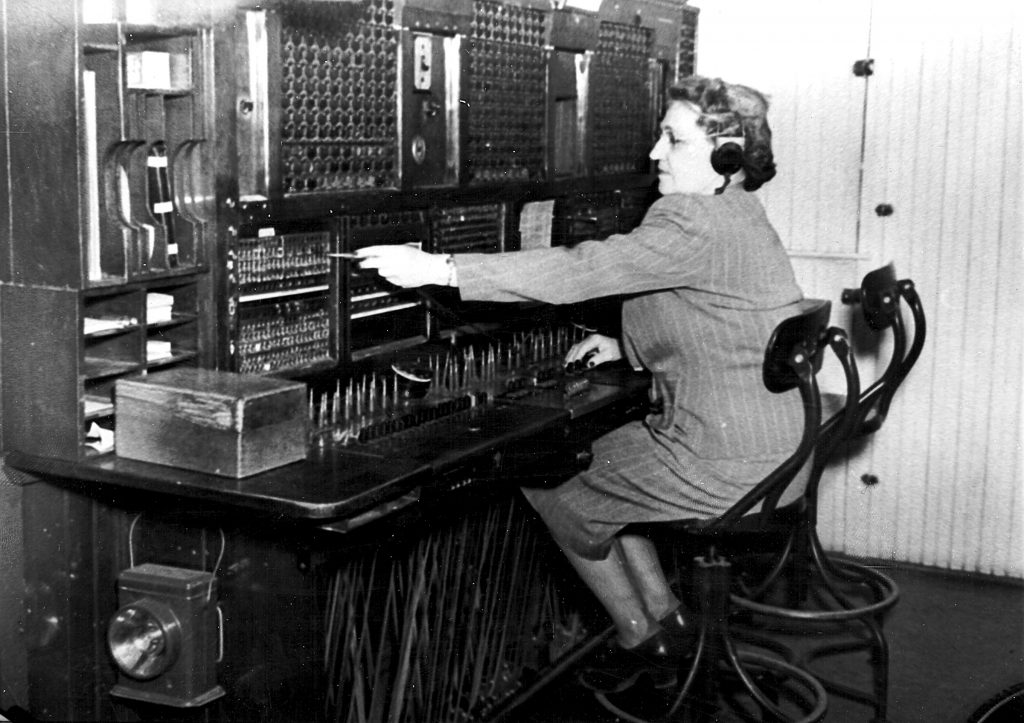
New York Telephone Company purchased the operation in 1932. When workers renovated the office, they found an 1834 copper penny in the corner of the foundation, making it the oldest “telephone building” in the state. The penny was framed and hung in the business office.
New technology
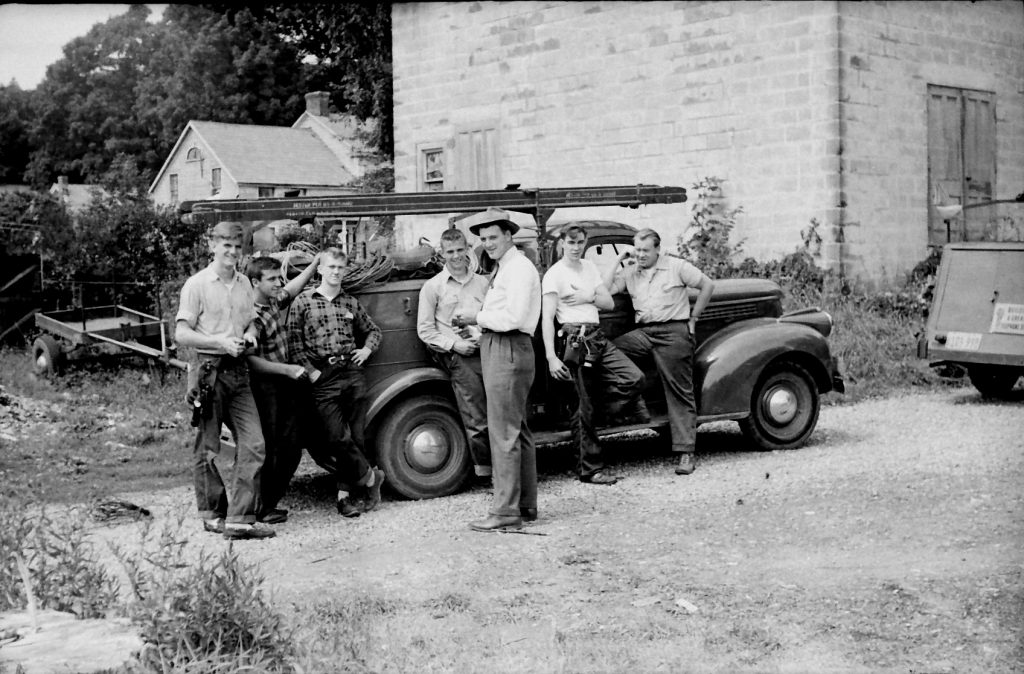
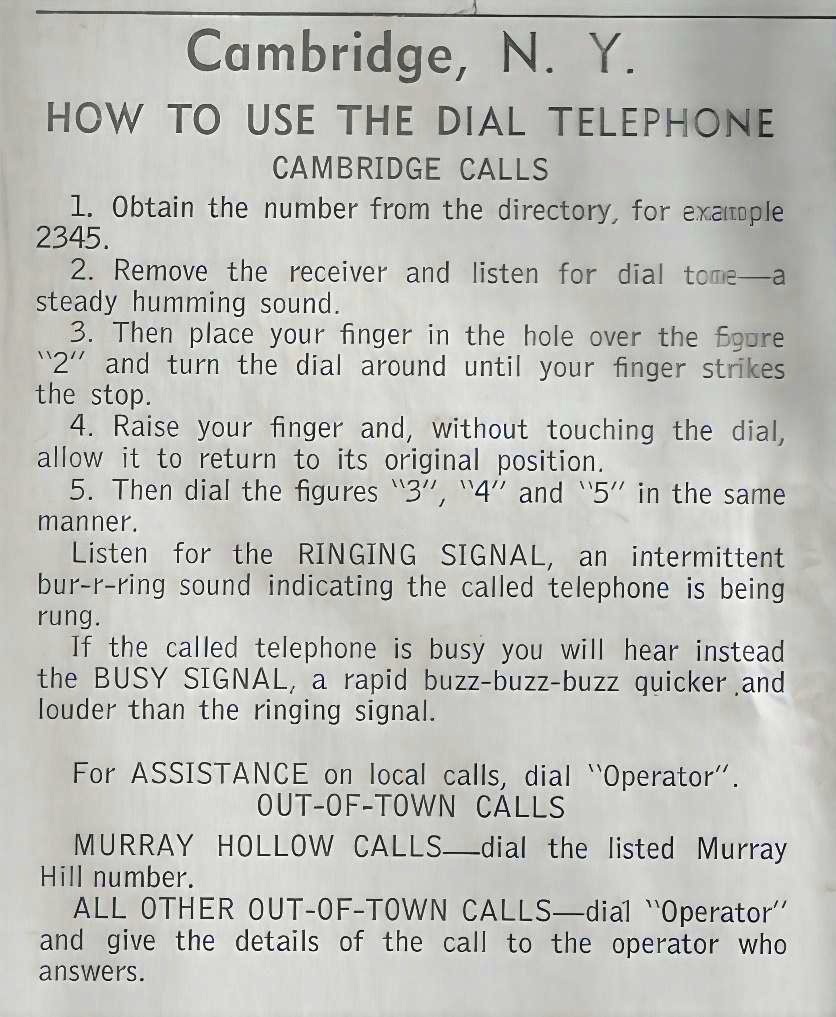
The switchboard operator was gone. Residents had to be instructed how to use the new-fangled “dial telephone”. Here’s the instructions printed in Cambridge’s first telephone directory
Next time
Next week we’ll move on to the other two major events of 1891: the Cambridge Fair and after that the Cambridge Union School.