On 26-Apr-2016 the Village of Cambridge celebrates the 150th anniversary of its incorporation. This series explores the events that led to the union of the West End and the East End. Last week we talked about the Cambridge Swamp, a physical division between “the corners”. This week we’ll cover other obstacles that separated the West End and the East End.
One of the first splits between “the Corners” was caused by the Presbyterian churches. That’s right, “churches”, plural.
The Protestant Presbyterian congregation was organized in 1769. Construction of the first church started in 1775 on the Turnpike near the County Route 71 intersection but was not finished until after the Revolutionary War. There is a historic marker there and a cemetery nearby.
By 1785, one faction of the congregation felt the church had become too lenient. They split off and formed the Yellow Meetinghouse in Stephenson’s Corners. That evolved into the Coila Presbyterian Church.
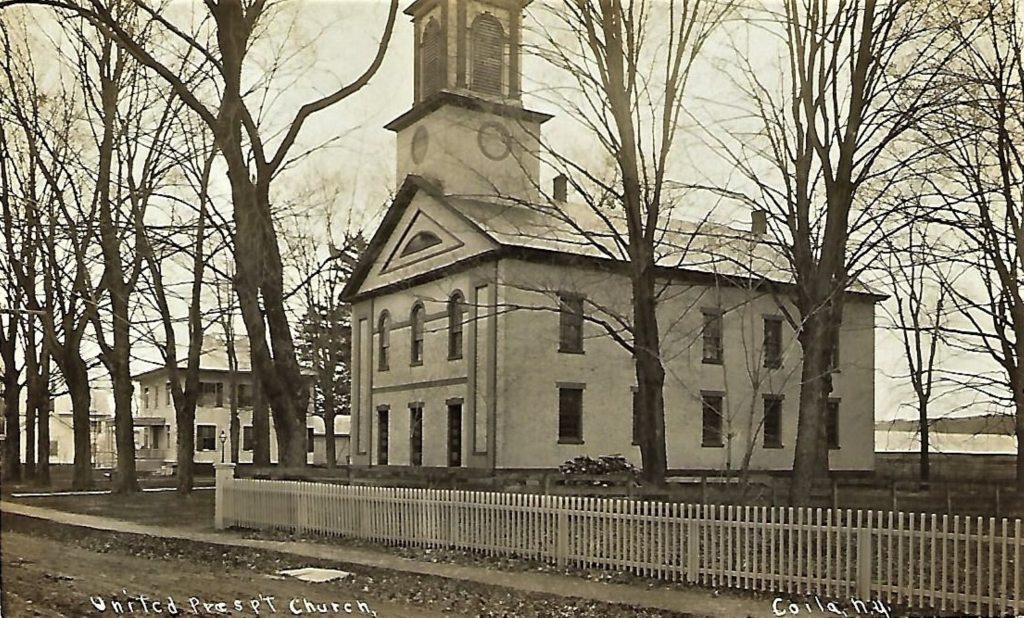
In 1792, another faction felt the original Presbyterian congregation was too strict. They split and built a white church on the northeast corner of Main and Park streets. It was located where Rite Aid is today and faced south toward Main Street. That’s why there is a cemetery on North Park Street.
[Note: The 1792 church was torn down in 1832 and the Old White Church (see photo) was erected on the location. In 1872 the current Presbyterian Church was erected across the street and the 1832 church became a meeting hall. In the 1960s the second church, then the Grange Hall (see photo), was torn down to make room for the A&P grocery store.]
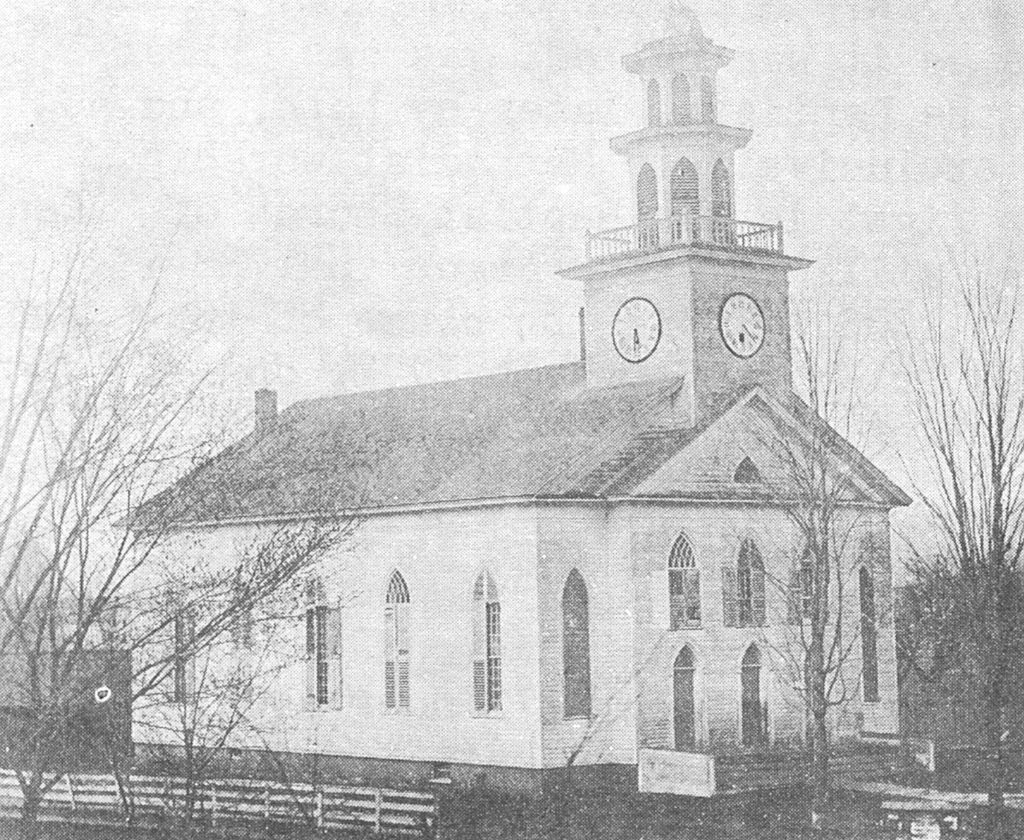
The three Presbyterian churches created the first of many splits that had to be overcome before “the corners” could unite and become the Village of Cambridge.
Another split occurred over stage coach traffic. From 1799-1804 the Great Northern Turnpike was constructed between Lansingburgh and Granville making Turnpike Road part of the only direct route from NYC to Canada. Cambridge Corners at the intersection of the Turnpike and Main Street prospered as hotels, liveries, and businesses sprouted to support the stage coach traffic.
In the early 1800s, the Shunpike Road just south of Cambridge diverted some traffic from the Turnpike to what is now NYS Route 22. This allowed stage coach traffic to bypass (shun) the toll booth on the Turnpike, passing instead through the East End along what is today Park Street. This helped the economic development of the East End but angered the West End.
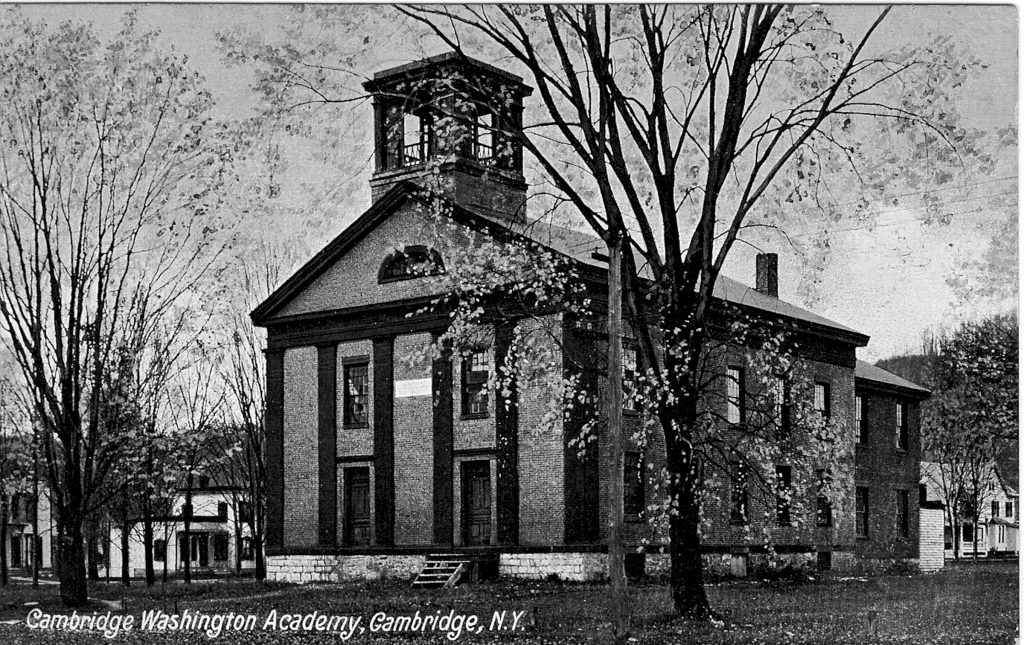
A third split between the West End and East End was over school. In 1799 the East End and West End voted and agreed to build a school. A second vote was held to determine the location of the school and few East Enders attended that vote. Perhaps it had rained and they couldn’t navigate the Cambridge Swamp to get to the voting place. Those who did vote agreed to build the Cambridge Washington Academy (see photo) on the West End at the intersection of what is today Academy and Pleasant streets. The East Enders refused to support the construction of the West End school.
The division between the East End and West End was now physical, religious, emotional, and economic. How would they ever unite into the Village of Cambridge? Would the union include Dorr’s Corners? What about Stephenson’s Corners (Coila)? In the next article, we’ll see how the groundwork for unity was built on fire, drunkards, pigs, and even a circus clown.